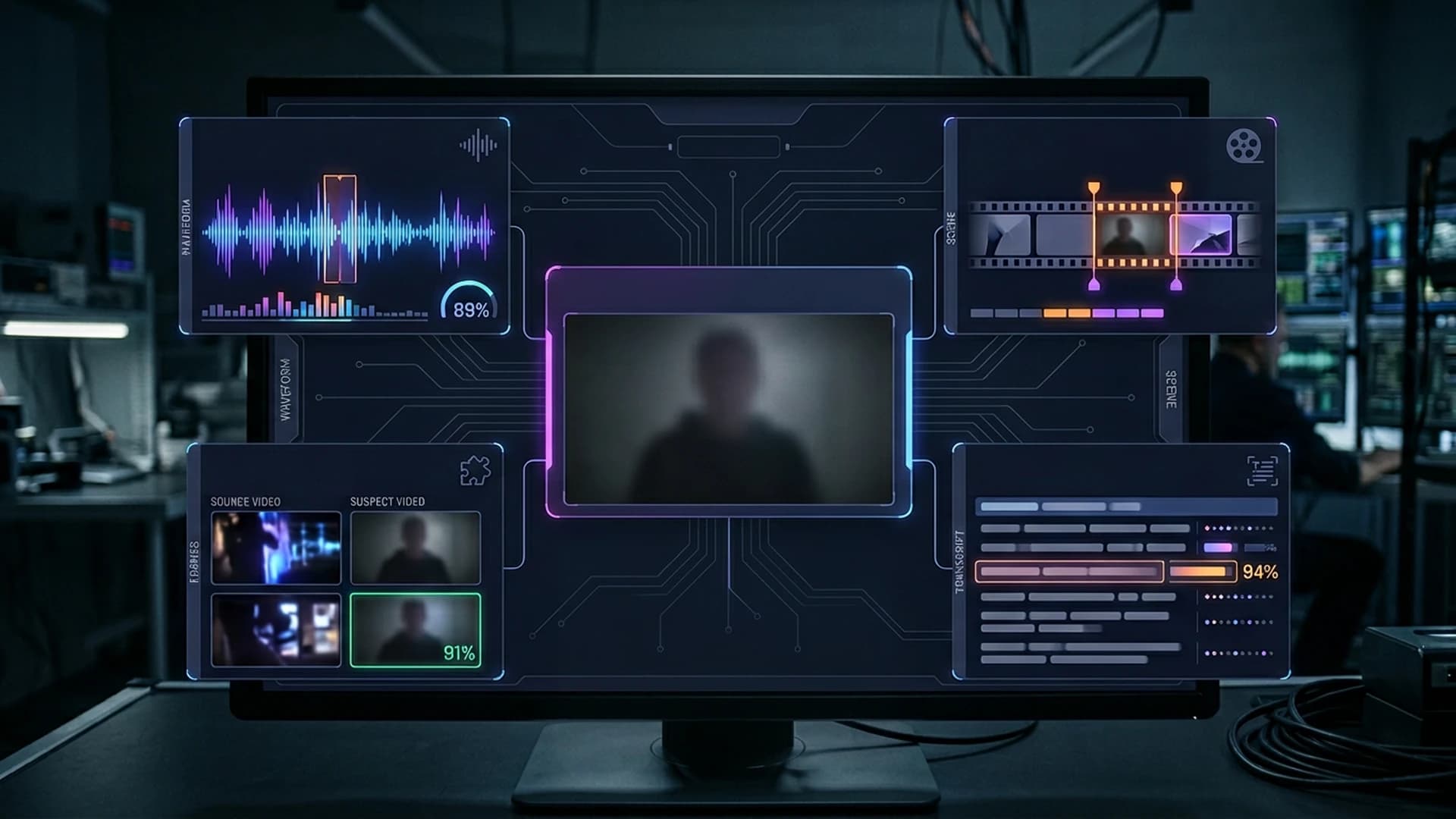
Short answer: The six signals that reveal a stolen YouTube video are title, description, tags, transcript, narration style, and thumbnail similarity. Check all six together — copycats change visible packaging while keeping your script, metadata, or delivery pattern.
Detecting a stolen YouTube video is rarely as simple as spotting an identical title. Sophisticated copycats know that changing a few words in a title or swapping out a thumbnail is enough to slip past a quick manual search — which is why effective YouTube copyright protection relies on analysing multiple signals at once. If you only check the surface, you will miss the copies that are costing you the most.
The six signals defined
- 1. Title similarity
- Catches obvious reuploads and lazy keyword clones.
- 2. Description language
- Often copied verbatim when copycats rewrite the title.
- 3. Tag patterns
- Reveals niche keyword sets lifted from your research.
- 4. Transcript / script
- Exposes paraphrased or lightly edited script theft.
- 5. Narration style
- Catches re-voiced uploads that defeat audio fingerprinting.
- 6. Thumbnail similarity
- Surfaces disguised uploads that look unrelated in search.
What copycats change vs what still matches
| Signal | What copycats change | What often still matches |
|---|---|---|
| Title | Reword, add clickbait, translate | Core phrasing, keyword order, episode numbering |
| Description | Trim intro lines, swap links | Keyword blocks, timestamps, CTA structure |
| Tags | Drop a few tags, reorder | Niche keyword clusters copied wholesale |
| Transcript | Light paraphrase, TTS rewrite | Argument flow, examples, section order |
| Narration style | Different speaker or synthetic voice | Pacing, emphasis, linguistic patterns |
| Thumbnail | Recolour, crop, add text overlay | Composition, subject framing, colour palette |
Deep dives: description and tag theft, thumbnail theft, transcript plagiarism, how copycats disguise stolen videos, compilation channel theft.
Why Single-Signal Checks Leave Creators Exposed
Most creators who suspect a reupload start with a title search or a reverse image lookup. That approach catches lazy copycats, but it does nothing for the ones who put even minimal effort into disguising the theft. A re-edited video with trimmed intros, reordered segments, and a rewritten title looks completely original to a surface-level check — yet the core content, the ideas, the script structure, and even the spoken narration may be lifted almost word for word from your channel.
Each signal on its own can produce false positives or miss a disguised copy entirely. Analysed together, they create a fingerprint of your original work that is far harder for a copycat to erase. That is the principle behind AI-assisted comparison — cross-referencing all six signals simultaneously so that nothing slips through the gaps.
Turning Signal Analysis Into a Practical Protection Routine
Understanding which signals matter is useful; acting on them consistently is what actually protects your channel. Schedule regular scans across all six signals rather than relying on ad-hoc searches — many reuploads appear weeks or months later, once the original video has gained traction. See how to tell if your video was copied for a step-by-step workflow.
GuardMyVideos scans YouTube for candidate copies and returns ranked results with signal context drawn from all six dimensions. AI-assisted analysis, not legal advice.
Try trial scans free on your most-at-risk upload.
Frequently asked questions
- What are the six signals of a stolen YouTube video?
- Title, description, tags, transcript, narration or speech-style patterns, and thumbnail similarity. Each alone can miss disguised copies; together they form a fingerprint that is hard to fake.
- Can a stolen video pass a title-only search?
- Yes. Copycats routinely rewrite titles and thumbnails while keeping your script, tags, or description. Title search alone catches only the laziest reuploads.
- How do you catch re-voiced YouTube copies?
- Compare transcripts and narration-style patterns, not just audio fingerprints. Re-voiced uploads change the speaker but often keep your script structure and pacing.
- Which signal catches metadata theft?
- Description and tag overlap often reveal copies when footage was re-edited. See our description and tag theft article for how copycats exploit your SEO work.